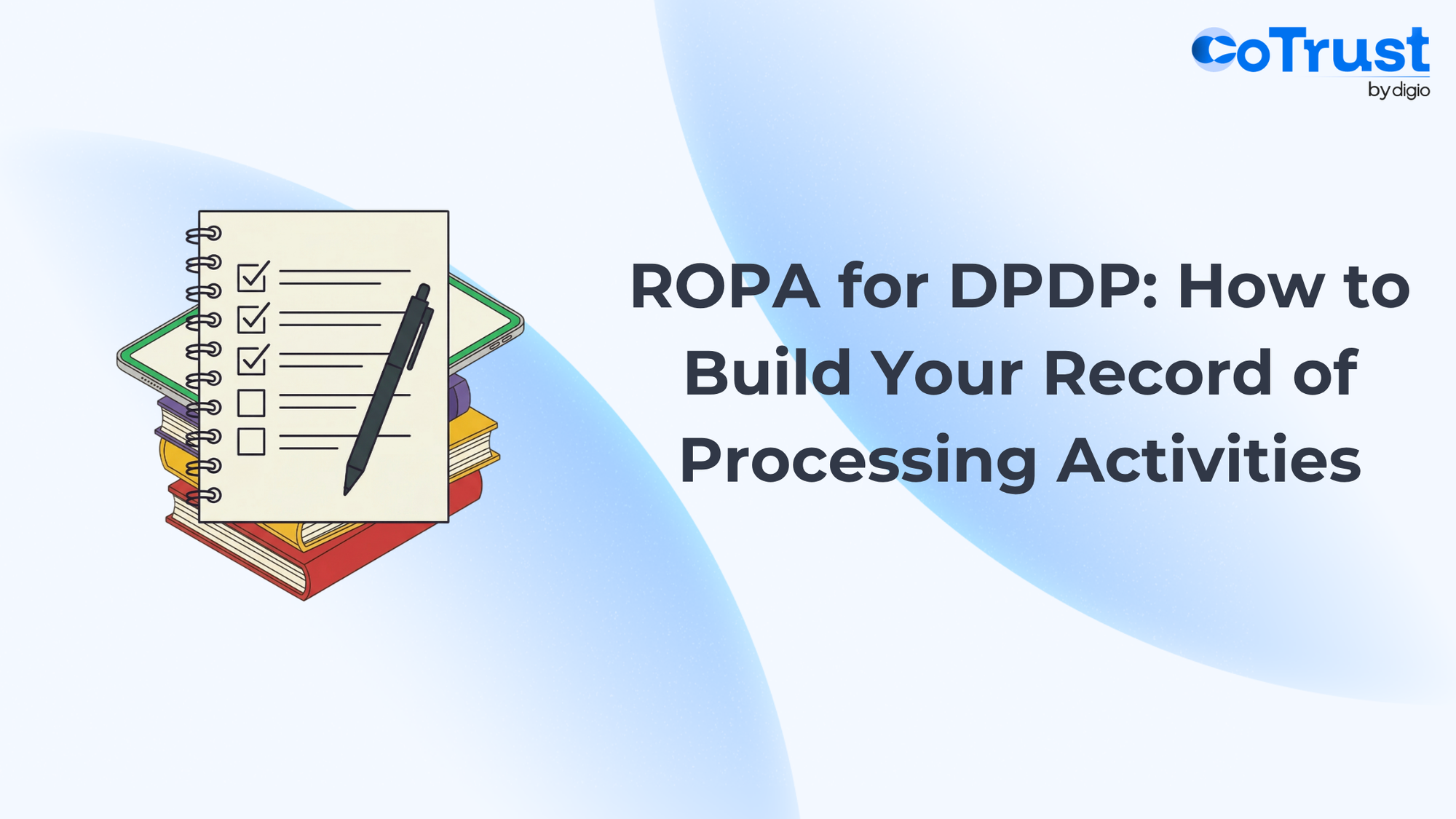
ROPA for DPDP: How to Build Your Record of Processing Activities
Step-by-step guide to building ROPA for DPDP compliance: templates, automation, and how consent governance feeds into your processing records.
A Record of Processing Activities (ROPA) is the backbone of DPDPA compliance. It's the single document that maps what personal data your organisation processes, why, how, and with whom it's shared.
When the Data Protection Board comes knocking, your ROPA is the first thing they'll ask for.
Yet most organisations treat ROPA as a checkbox exercise, a spreadsheet maintained by the legal team that goes stale within weeks. Under DPDPA, that approach creates regulatory risk. This guide shows you how to build a ROPA that's accurate, maintainable, and directly connected to your consent governance infrastructure.
What Is ROPA Under DPDP Rules 2025?
ROPA under DPDPA serves a similar purpose to its GDPR counterpart (Article 30), but with India-specific nuances. It is a comprehensive register that documents:
- What personal data do you collect (name, PAN, Aadhaar, email, phone, financial data, biometrics)
- Why do you collect it (the specific processing purpose: account opening, marketing, credit assessment)
- Legal basis for each processing activity (consent, legal obligation, emergency, state function)
- Who has access internally (which departments, which roles)
- Who you share it with externally (third-party processors, partners, regulators)
- How long you retain it (retention period per purpose)
- What security measures protect it (encryption, access controls, audit logs)
- Cross-border transfers, if any (DPDPA restricts transfers to non-notified countries)
Under DPDPA, Significant Data Fiduciaries (SDFs) are explicitly required to conduct Data Protection Impact Assessments (DPIAs) and periodic audits.
ROPA is the foundation on which both of these exercises depend.
Step-by-Step ROPA Template
Here is a practical template you can use.
Each row represents one processing activity:
ROPA Template Fields
Tip: Maintain separate ROPA entries for each distinct processing purpose. "Customer Onboarding" and "Marketing Communications" are different activities, even if they process some of the same data. This granularity is what regulators expect.
How Consent Governance Feeds Into ROPA
The most common ROPA failure is that it becomes a static document disconnected from actual data processing. Consent governance solves this by making ROPA a living, automatically updated record.
Here's how the connection works:
Consent Platform → ROPA (Automated)
- When a new processing purpose is created in your consent management platform (e.g., "Marketing - WhatsApp campaigns"), the ROPA should automatically get a new entry.
- When consent is captured, the ROPA entry updates with: number of consenting data principals, consent capture method, notice version shown.
- When consent is withdrawn, the ROPA reflects the updated consent status and triggers retention review. If no other legal basis exists, data must be erased.
- When a third-party processor is added to a purpose, the ROPA updates the "External Recipients" field.
ROPA → Compliance Operations
- DPIA: The ROPA identifies which processing activities are high-risk and need a full Data Protection Impact Assessment.
- Audit: External auditors use the ROPA as the starting point for their compliance review.
- Breach response: When a breach occurs, the ROPA tells you exactly which data principals and what data is affected - critical for the 72-hour notification window.
- DSR fulfilment: When a user requests data access, the ROPA maps where their data lives across all systems.
A ROPA that isn't connected to your consent platform is a compliance risk masquerading as a compliance document.
Why Manual ROPA Fails at Scale
Most organisations start with a spreadsheet. Here's why that breaks down:
ROPA by Industry
Banking & Financial Services
Banks have the most complex ROPA requirements due to the volume of processing activities (account opening, lending, payments, insurance distribution, wealth management) and the number of regulatory overlays (RBI, SEBI, IRDAI + DPDPA). A typical bank's ROPA may have 50-100+ processing activity entries.
Fintech & Digital Lending
Fintechs process data across the lending lifecycle: lead generation, underwriting, disbursement, collection, and recovery. Each stage involves different data categories and different third-party processors. ROPA must clearly delineate consent boundaries, especially for data shared with credit bureaus and collection agencies.
Insurance
Insurance companies process sensitive health data, nominee information, and claims data. ROPA must account for IRDAI-specific retention requirements alongside DPDPA consent obligations. Particular attention needed for third-party data processors (TPAs, hospitals, surveyors).
E-commerce & Consumer Internet
High volume of data principals (often 10M+), heavy marketing data usage, and complex cookie/tracking ecosystems. ROPA must map all tracking technologies, advertising partnerships, and analytics tools processing user data.
Explore CoTrust: Consent Governance that keeps your ROPA always audit-ready
Frequently Asked Questions
Q: Is ROPA mandatory under DPDPA?
A: While the DPDPA does not use the term "ROPA" explicitly, the Act and Rules require data fiduciaries to maintain records of all processing activities, consent artifacts, and security measures.
Significant Data Fiduciaries (SDFs) must additionally conduct periodic audits and Data Protection Impact Assessments, both of which require a comprehensive processing record.
In practice, ROPA is the standard format for meeting these obligations.
Q: How is ROPA under DPDPA different from GDPR's Article 30?
A: GDPR Article 30 ROPA focuses on documenting processing activities, legal bases, and safeguards.
DPDPA ROPA adds India-specific requirements: consent artifacts with cryptographic proof (SHA-256), 22 language notice versions, consent withdrawal tracking, and the consent-to-execution chain (proving that consent revocation actually stopped processing).
Additionally, DPDPA's emphasis on purpose limitation means each processing purpose must be more granularly documented than typical GDPR ROPAs.
Q: How often should ROPA be updated?
A: ROPA should be a living document, not a quarterly exercise.
Best practice: connect ROPA to your consent management platform so it updates automatically when processing purposes, consent status, or third-party processors change.
At a minimum, formal reviews should happen quarterly, with ad-hoc updates whenever new processing activities are introduced, new processors are onboarded, or significant consent withdrawal events occur.
This content is for informational purposes and does not constitute legal advice. Consult qualified legal professionals for advice specific to your circumstances.
Read more Blogs
DPDP Consent Management: What Every Data Fiduciary Must Know in 2026
How DPDP consent management works: consent capture, lifecycle, consent managers, and what data fiduciaries must implement before May 2027.
DPDP Compliance Platform: Complete Guide for Indian Enterprises (2026)
Everything Indian enterprises need to know about choosing a DPDPA compliance platform: features, deployment options, timelines, and penalties. Updated for 2026.
DPDP Compliance for Banks: A CISO's 90-Day Roadmap
Indian banks sit at the intersection of two regulatory forces: the Reserve Bank of India's Data Governance Guidelines and the Digital Personal Data Protection Act, 2023. With full DPDPA enforcement beginning May 13, 2027, and penalties reaching ₹250 crore, banks face the highest compliance stakes of any sector. The challenge isn't just regulatory, it's operational. Banks handle tens of millions of data principals across dozens of digital properties (mobile apps, net banking, UPI, loan portals,

Digitally transform business operations with Digio!
Try first. Subscribe later.
Boost your legal ops efficiency by 80%
Learn how Digio can enhance your business productivity
Get 1-on-1 business use case solutioning
Speak with our business consultants to get a solution walkthrough for your business requirement
Test the APIs
Let your development team test our API suite to understand configurability and product integration
Subscribe
Get the best in industry commercials for your business usecase